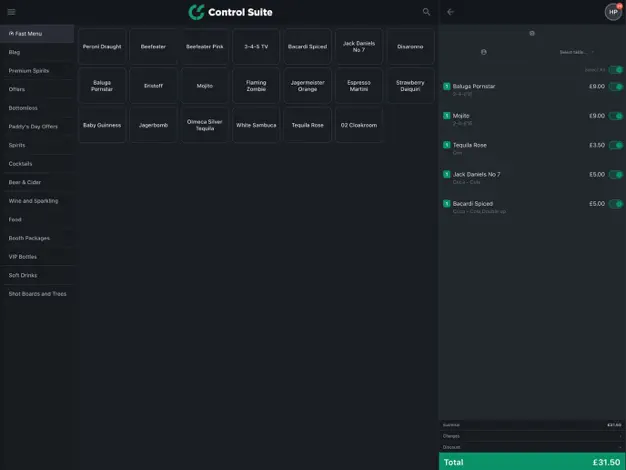
Choose your EPOS on three things: how fast a real sale is at your busiest till, what it connects to out of the box, and whether you can see all your sites in one honest report. Everything else on the feature list is decoration. I run a seven venue group and wrote the platform it runs on, and every bad till decision I've watched an operator make came from judging the demo instead of judging the joins.
Why the feature list is the wrong place to start
Every serious till system does the basics: menus, modifiers, tabs, splits, discounts. The demos all look the same because the demos are the product's best moment. The differences that will cost or make you money are less photogenic: how many taps a vodka and Coke takes at 11pm, whether your bookings platform writes to it, whether the stock figure it holds is one anyone believes, and what its export looks like when your accountant opens it.
What should the shortlist test actually be?
Time a real sale
Get the trial kit on a bar, not a boardroom table. Ring in your ten most common orders and time them, card tap to done. A busy server has around eighteen seconds per drink at peak, pouring included. If the till wants thirty of them, you don't serve a hundred drinks in the rush half hour, you serve sixty, and no monthly fee is small enough to buy that back.
List the joins before the features
Write down every system that must talk to the till: bookings, payments, stock, delivery platforms, accounting, rotas. Then make the vendor show you each connection working, live, not on a slide. "We have an API" is not an integration. An integration is your reservation appearing on the till without a human touching it.
Ask for the boring report
Ask to see the end of day export and the multi-site comparison report using dummy data. If you can't imagine your bookkeeper being pleased with it, the VAT return you do every quarter will tell you so at length.
Who this is for
- Operators running two or more venues on tills bought at different times for different reasons
- Groups opening a new site and tempted to just buy whatever the last site has
- Anyone whose current contract is up for renewal and wants to decide rather than default
- Founders who inherited a till with the building and suspect it's costing them
What it costs and what to expect
The till itself is rarely the big number. The real costs are the switch (training, data, a nervous first weekend) and the drag of choosing wrong (slower service and manual re-keying, every day, for the length of the contract). Expect a proper selection to take a few weeks of part-time attention: listing the joins, testing two or three finalists on a live bar, and negotiating the exit terms before you sign, not after. If you want a second pair of eyes, this is exactly the kind of defined job I take on, and it starts with a free half hour call via the contact page.
The one rule if you remember nothing else
A stack of six systems that talk to each other beats three that don't. Buy the till that plays well with others, because the expensive problems in hospitality tech are almost never inside one system. They live in the gaps between them.
Does this sound like something you need help with?
Book a free 30 minute call and tell me what's going on. If I can help, I'll say how. If I can't, I'll say that too.